Log on:
  • Log On


    Forgotten password

  • User Statistics

    There are 361 active users.
    (1 logged on.)

All blogs

You can filter this page to certain types of posts:

Filtered: Showing community blog posts (Remove filter)

May 24, 2008


Earthquakes on mid-ocean spreading ridges are very common, however they are usually smaller than M6.0 so this event (Mw=6.4) is quite unusual

Keywords: earthquake, KEYW

Posted by Paul Denton @ School Seismology | 0 comment(s)

May 23, 2008

From http://news.zdnet.co.uk/software/0,1000000121,39420717,00.htm:

"A collaboration between the UK government and Google has produced a new online tool for learning about climate change.

Named "Climate Change in Our World", the tool uses information from the Met Office's Hadley Centre and the British Antarctic Survey to provide two new layers, or animations, to all users of Google Earth.

...

One animation uses world-leading climate-science capabilities from the Hadley Centre to show global temperatures throughout the next 100 years under medium projections of greenhouse-gas emissions, along with reports of how people in the UK and in some of the world's poorest countries are already being affected by changing weather patterns.

... 

Another animation, developed by the British Antarctic Survey, shows the retreat of Antarctic ice caps since the 1950s, and features facts about the science and impact of climate change in the Antarctic."


Keywords: climate change, google earth, sea ice, temperature

Posted by Jon Blower @ Geobrowsers | 0 comment(s)

May 16, 2008

Here's a useful-looking piece of software for creating Google Maps more easily.  In fact there's lots of interesting geospatial stuff at the CASA website. 

http://www.casa.ucl.ac.uk/software/googlemapcreator.asp

Posted by Jon Blower @ Geobrowsers | 0 comment(s)

MapTube allows you to quickly visualize multiple maps together in a Google Maps interface. 

From the MapTube website:

"MapTube is a free resource for viewing, sharing, mixing and mashing maps online. Created by UCL's Centre for Advanced Spatial Analysis, users can select any number of maps to overlay and view"
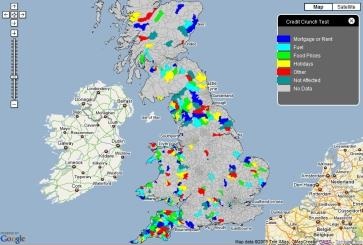
http://www.maptube.org

MapTube screenshot - credit crunch 

Keywords: Google Maps, mashups

Posted by Jon Blower @ Geobrowsers | 0 comment(s)

What is the point of seismology if it cannot predict or prevent earthquakes? As the casualty figures from China approach 50,000 this is a question that you might find yourself being askled or asking yourself. It is a very important question that every seismologist has to answer at some point in their career. I usually end up talking about the things that seismology has been able to do. We have been very succesful at probabalistic analysis of earthquakes. For any location on the planet it is possible to calculate fairly accurately what the probability that a certain threshold of ground shaking will be exceeded within a 50 year period. This is not useful for evacuating populations before a big event but it is used extensively to ensure that building codes in earthquake prone zones are sufficient to withstand the likely effects. Unfortunately many earthquakes happen in areas where building codes are not adhered to or have many buildings thta are too old to be covered by these recent advances in understanding. In many cases effective mitigation of the effects of earthquake is a political and economic problem rather than a technical scientific one. Scientists need to ensure that the results of their research is communicated effectively to those in power in the field of seismology as much as in other fields (eg climate change)

Posted by Paul Denton @ School Seismology | 0 comment(s)

May 12, 2008

A large earthquake (reported by USGS as Mw=7.8 or 7.9 Ms=8.0 or Mb=7.1 reported magnitude has been upgraded from 7.8 to 7.9) hit China this morning. Earthquakes in China are potentially devastating, initial reports on the BBC suggested that this was a sparsley populated area and many buildings in cities nearby were evacuated no casualties had been reported by(09:30). UPDATE by 5pm there are reports of 8000 fatalaties (including an entire school). This number of casualties is only likely to increase as rescuers reach the affected areas.

The event was spotted by George Marshall at Robert Smyth school on his seismometer before he checked the news.

The signal at KEYW shows P(06:39) PP(06:42) S(06:49) SS(06:53) Surface Waves(7am onwards). The Surface waves registered near the maximum possible on the SEP system (30,000 counts) giving a an estimate of surface wave magnitude >8.5. If you did not record this event then your station is not working.
more info on this event at http://earthquake.usgs.gov/eqcenter/recenteqsww/Quakes/us2008ryan.

Keywords: CHINA, Earthquake, KEYW

Posted by Paul Denton @ School Seismology | 2 comment(s)

May 10, 2008


21:51:31 9th May M 6.7 Earthquake Guam


Pete hill

Paulet

Keywords: earthquake, Guam, PAUL

Posted by Pete Hill @ School Seismology | 0 comment(s)

May 07, 2008


A series of events offshore Japan, M6.2 at 16:02, M5.9 at 16:16 and M6.8 at 16:45. The signal at KEYW looks very confusing with the surface waves from the first event overlapping with the body waves from the last one.

Keywords: earthquake, japan, keyw

Posted by Paul Denton @ School Seismology | 0 comment(s)

Dave Butler at WINWM in Dudley recorded the Aleutian event as his first earthquake (slightly better quality data than KEYW!). Congratulations Dave

Keywords: aleutians, earthquake, winwm

Posted by Paul Denton @ School Seismology | 0 comment(s)

May 06, 2008

This blog entry describes a really nice KML dataset from Columbia University that shows temperature trends at thousands of stations around the world.  Pins are sized and coloured according to the degree of warming and cooling and can be clicked to show detailed data from each station.

http://www.gearthblog.com/blog/archives/2008/03/global_temperatur 

Posted by Jon Blower @ Geobrowsers | 0 comment(s)

<< Back